Welcome to the Dojo! We practice English here by learning from our mistakes, that’s why we call it a どう場, How’s My English場。
Even if your English is terrible, your ideas are important. Let’s make sure your ideas are easy for people to understand.
Here you can check and improve your English by Speaking, Listening, Reading, and Writing. Most of these things you can do by yourself, but it is always better to do these with a friend. It’s nice if they speak English, but the important thing is to have another set of eyes and ears on what you are doing. It is very difficult for us to see our own mistakes and answering other people’s questions is teaching. And teaching is learning.
You will see explanations of what to do. Worksheets to help you do it and videos modelling the practice.
Try it, you’ll like it.
SPEAKING
A great way to practice speaking is to listen to yourself speaking. And the bet way to listen is to be quiet. That’s really hard to do. There is a way called The Silent Way. I think it is a really good way, and this is how I understand it. Keep quiet in your mind. The quieter you are, the more you will hear.
1 Record yourself speaking.
2 Write down EVERYTHING that you hear.
3 Revise and improve what you said.
4 Record yourself again.
Surprise! 🙂
TL;DR
LISTENING
A big part of speaking practice is listening to yourself speaking. We do, of course, need to listen to other people. Part of that is learning to be quiet in ourselves so that we truly are listening to the other person. The other part is letting the other person know what we hear them saying. This shows them that we are paying attention and listening to them, confirms what we have understood and encourages them to say more because they know they are being heard.
Good listening involves thoughtful speaking. Think of it as active listening, just the opposite of tuning people out with headphones on the subway. There’s a lot more to do and we have worksheets to help with that here, but first things first. Let’s practice focus and focusing.
1 LISTEN
2 REPEAT: Tell the speaker what you heard them say.
3 CHECK: Ask the speaker to repeat anything you id not understand.
4 ASK: Ask questions to learn more and continue the conversation.
REPEAT and CHECK help us stay focused and paying attention. ASK encourages the speaker to share more of their story.
The Silent Way is an approach to learning that emphasizes silence.
The teacher keeping silent by keeping their mouth shut. The students cultivating silence by keeping their minds open. By learning to listen well. Not an easy thing to do.
One person speaks. One person listens.
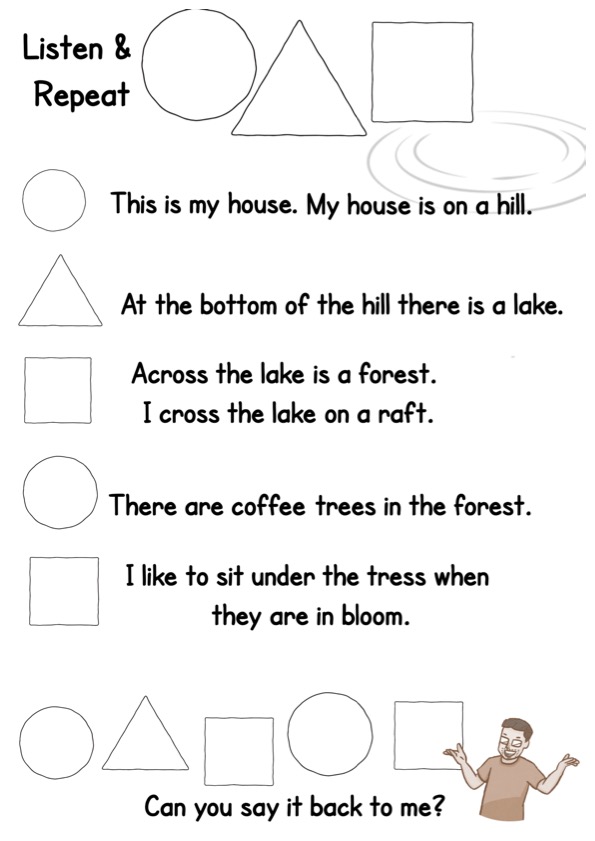
The speaker tells a short story, usually describing a place that only they know. This is important because it keeps the listener focused on what the speaker is saying and not caught up in their own ideas about the place.
As the speaker tells their story they place blocks down to represent places or ideas, for our activity sheets I use shapes.
Every sentence or two the speaker stops and the listener repeats what they heard. It is not a test. If you don’t remember everything that is ok, repeat what you can. It is important to repeat exactly what the speaker says. That shows you are listening to them and reinforces the idea that this is their story not yours, the listener. If the speaker says, ‘This is where I live’ the listener needs to say back ‘This is where you live’. Not ‘This is your house’, the speaker didn’t say that. If the listener repeats back ‘this is your house’ it becomes the listener’s story not the speaker’s.
It is harder to do then we think. Because we often do turn other people’s stories into our own. You might say ‘house’, I hear ‘home’. Home is beautiful to me, warmer. I like the image it creates in my head of a snowy day, a chimney and a fire… and I am not listening to you anymore. I am daydreaming about home, my home, and not thinking about the house you are telling me about.
The listener repeats what the speaker says. When the story is finished the listener repeats it on more time. You said a,b,c,d,e.
If the listener forgets something that is ok. The listener can say you said a,b,_ ,d,e. After they repeat what they know, the listener can go back and check for information they don’t remember. Point at C, and ask, ‘What is this?’. And of course repeat what the speaker says. If the speaker says ‘That is where I live’, the listener will point at C again and say, ‘This is where you live.’
If other people are listening they can now be invited to repeat something that they heard. They can do a,b,c,d,e if they want. If they only want to say one thing, that is fine. They can point at C and say ‘this is where you live’. At this point people are ONLY repeating what the speaker said. It is still the speaker’s story and we are all listening to them.
Next the other people can be invited to check on information. Ask about something the speaker said that they did not hear or do not remember. They can point at B and ask, ‘What is this?’
The last step, after we have shown the speaker that we are listening to them, we can ask for new information. You could point at C and say, ‘You said this is where you live. What kind of place do you live in?’
It seems so simple. In a way it is. It is also not the way we normally listen to each other. And not the way people normally listen to us. To have people truly paying attention, and demonstrating they are paying attention, is deeply moving. For people who are shy or nervous about speaking English it is incredibly empowering. It shows them people are listening to me and want to understand me.
Try it with a friend. Read them this short story one line at a time.
1 Keep the story secret, give your friend the blank activity sheet.
2 Point at the shape for each line on their paper and read the line to them.
3 Have them repeat what you said.
4 At the end of the story have them repeat as much as they want.
It’s not a test, but a good way to experience how we really listen to each other. Try flipping the roles and have your friend share a story for you to actively listen to.
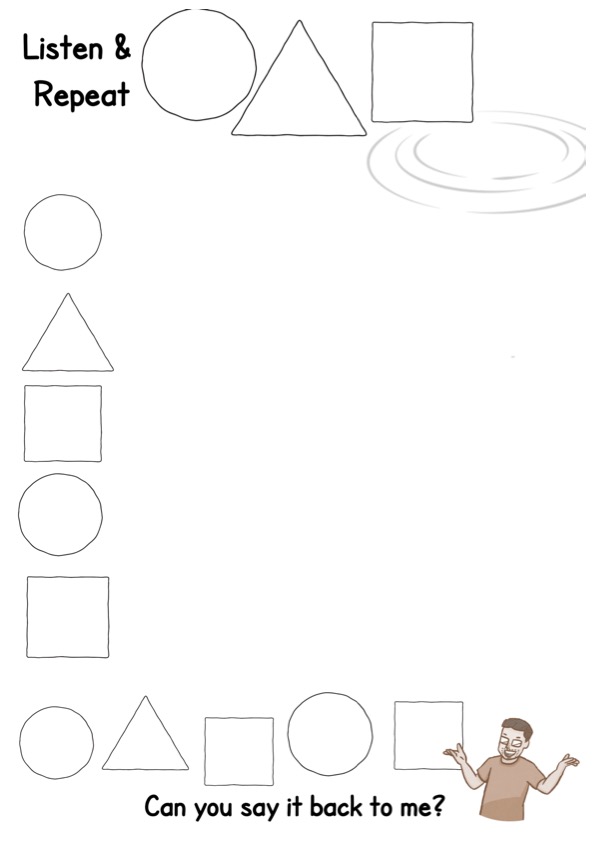
Like I said, there’s always more to practice. When you are ready, follow this link for more strategies and worksheets.
READ. Read, read, read, read, read.
Read good books. Books you enjoy reading.
This is the best way to improve your English.
This is the way American kids become better speakers of English.
This is the best way to prepare for all the crazy tests you’re going to take.
Read.
I’ll help you. I’m going to suggest some books to you. Good books. They are well written. They are wonderful. They are books that I keep reading again and again because I enjoy them so much, and I learn from them. I hope you will too.
WRITING
We learn from our mistakes. We learn from doing. And doing, and doing. So let’s go. Let’s write. A lot. Writing helps with learning because we can easily look back at the before and after, see the changes we made and why.
I goes to school.
The mistake is ‘goes’. This is a problem with subject verb agreement. The subject is ‘I’ so the verb should be in the first person singular, ‘go’. ‘Goes’ is used for the third person singular, he/she/it.
Here are some strategies for daily practice. Try something different each day to keep your thinking flexible.
Finding and fixing our mistakes.
Write a short passage, about 5 to 7 sentences long.
Read what you wrote and look for 7 mistakes.
Fix the mistakes and rewrite the passage.
For an extra challenge you can try to describe the mistakes and how to correct them.
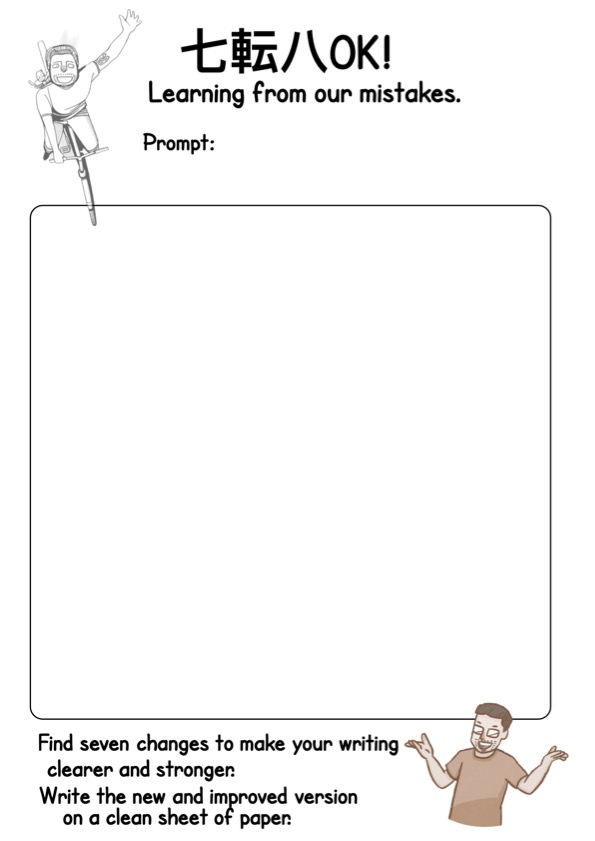
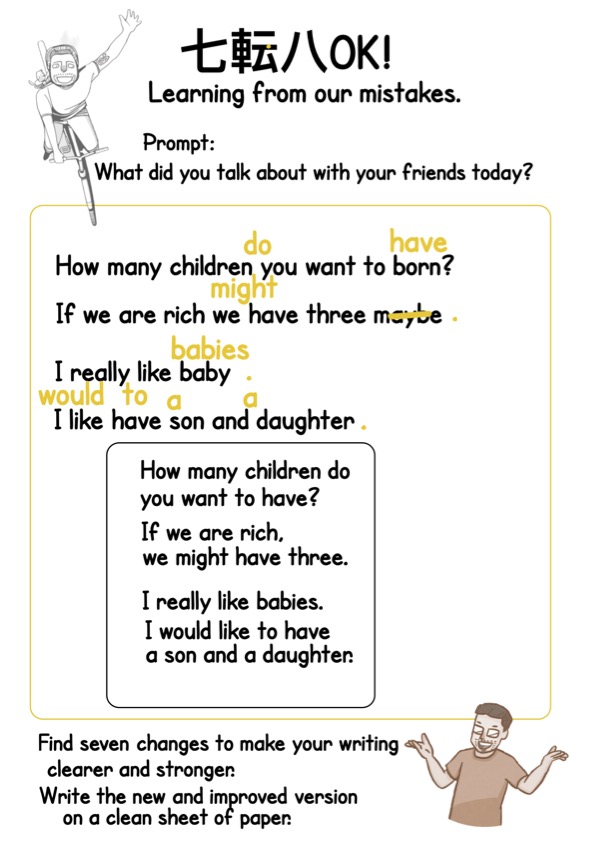

This is the first step to using our mistakes to improve our writing and our command of English. There is lots more to do. When you are ready follow this link for more strategies and worksheets.
Once we are sure people can understand us we can work on being persuasive. Using the beauty of English to show people how important our ideas are to us and help them think about things in new ways. These are not corrections but variations and improvements. And we can practice each aspect by following the links for LISTENING, SPEAKING, READING, and WRITING.
 英会バー
英会バー 