Everybody is trying their best. Thank you, Everybody!
Did you make a mistake? Daijobu, daijobu. We can make it better.
Look and Learn form the World Around You.
Walk down the street and see what kinds of English and what kinds of mistakes you can find in the wild. ‘In the wild’ is another way of saying in real life. The English we see in textbooks is always artificial. Too perfect and so too unreal. Out in the world English is imperfect and improvised, often wildly so. Wild in the sense of unbelievable and wonderful. Truly wonderful, the meaning and the intention it conveys. Sometimes people use the wrong words or sentence structure, and sometimes that prevents understanding. We can fix that. Other times it opens the doors to new understandings. we an celebrate that. And we can always appreciate the effort. These people are trying their best to use English. Is it hard to understand sometimes? That’s ok. Daijobu, daijobu. Thank you for trying and let’s work together to make it better.
I see great examples of this everyday, I bet you do to. Let’s discover a daily daijobu.
We are going to look at examples from the real world of the ways people use English. Most of these examples have something wrong about them. They are from countries where English is not people’s first language. I find them intriguing and enlightening. They really keep me thinking. I hope they will keep you thinking too.
For each daily picture ask yourself these three questions:
Is it understandable?
Is the English wrong?
How would you say it better?
For the big picture, ask yourself does it matter? Daijobu, daijobu. Everybody gets an A for effort.
I’ll tell you what I think for each item, but think for yourself first. Skipping ahead to my answers you will miss out on all the fun.
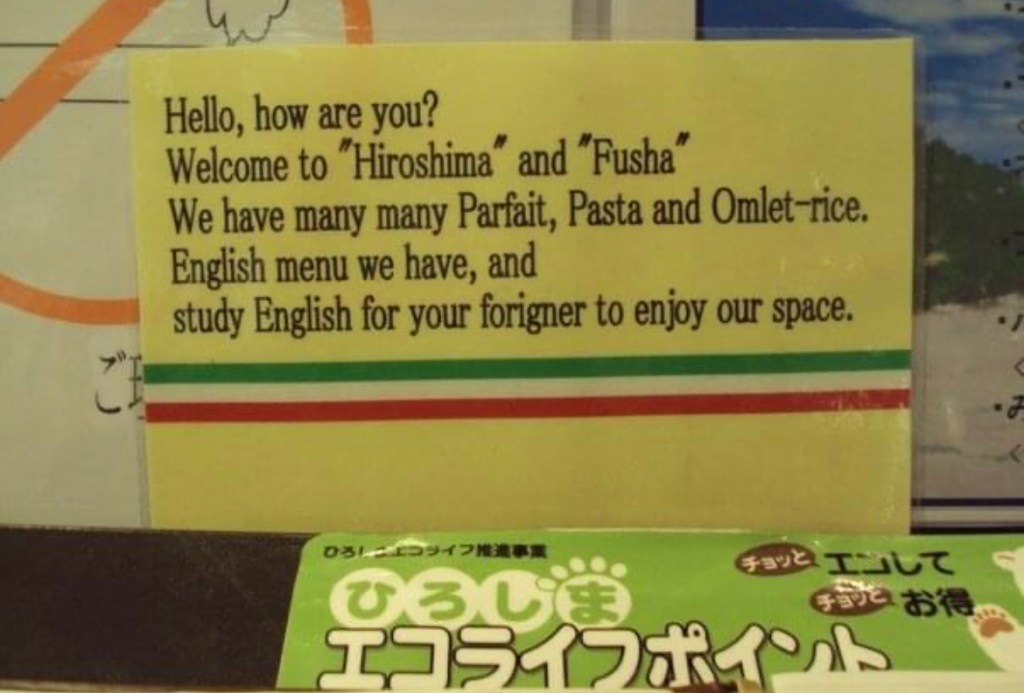
Is this understandable?
Is the English correct?
How would you write it differently?
I found this sign in Hiroshima and I found it wonderful. The English isn’t perfect but the sentiment is.
The English is understandable, they are welcoming foreign tourists to their restaurant and explaining what kinds of food they have.
I would write it this way:
Hello, how are you?
Welcome to Hiroshima and to Fusha. We have kinds of pasta, omelettes, and parfaits. We have English menus. We are learning English to help you feel welcome here.

Is this understandable?
Is the English correct?
How would you write it differently?
This is an ad I saw on the Keihan line in Kyoto many years ago before people had smartphones. I love this ad. It is so simple and clear. And clever. It’s an ad for Lumix cameras with flip screens, so you can preview your selfie.
The English is perfect. The sentence by itself has perfect meaning and in the context of the ad it has even greater meaning. You should love yourself and you should take selfies. I wouldn’t say it any differently. In fact I share this again and again, every chance I get.

Is this understandable?
Is the English correct?
How would you write it differently?
This was a grocery store in Nara, I think. I only wish I had thought of it first.
It is understandable if a bit modest. The name means this is a good store. The English is not correct, it is better than that. -Est is used for the superlative, the thing that is best. Good, better, best. Ok is a synonym of good, maybe a little less good than good. Ok, good, better, best. If this store is the most ok of all the stores than it is really the best. Best Fresh Mart.
I wouldn’t write it any differently though. Certainly not Best Fresh mart, that is predictable and boring. Okest stands out and is easier to remember because of the novelty of the name. I think too it is fitting for Japan. It may not be ok to say you are the best. But it is fitting and modest to simply say you are the Okest.
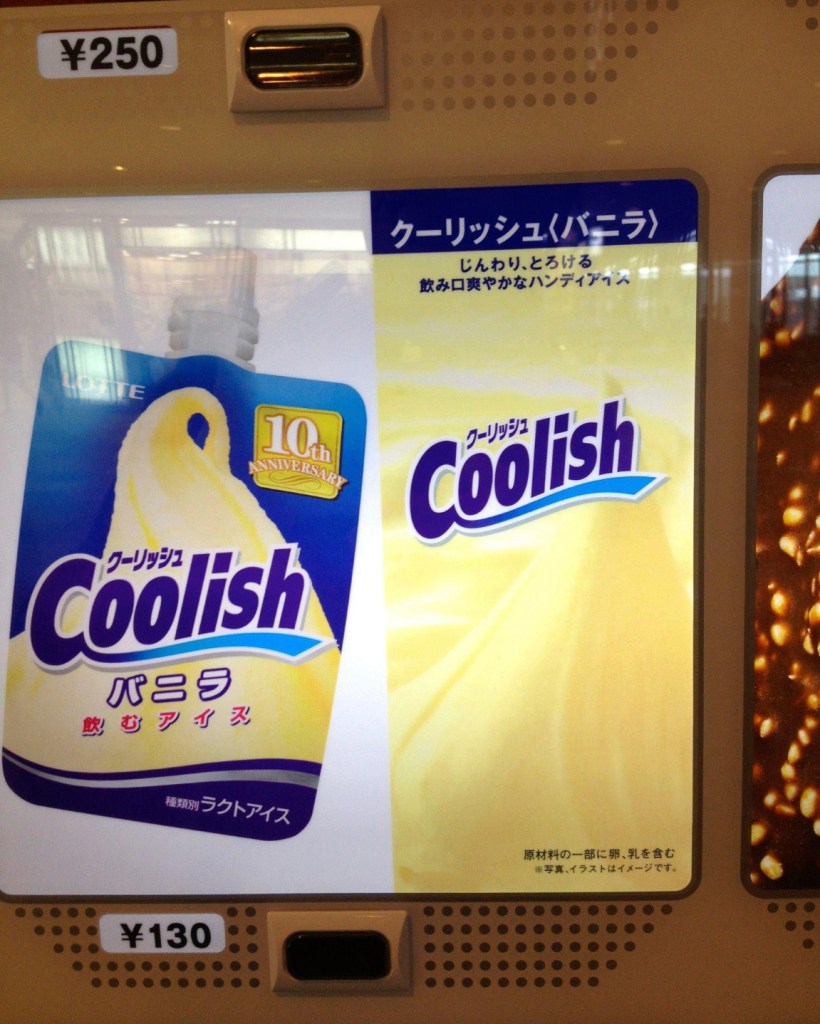
Is this understandable?
Is the English correct?
How would you write it differently?
You’ve probably seen this around. It is everywhere, and pretty good I think. ‘Coolish’ is understandable but a little bit confusing. It sounds like the ice cream is broken. It isn’t as cold as it should be. The English is correct, though we don’t often use -ish with temperature words. I would say ‘cooling’ instead of ‘coolish’. Coolish describes the ice cream, perhaps it is because the ice cream is soft. Cooling describes how you will feel eating the ice cream.
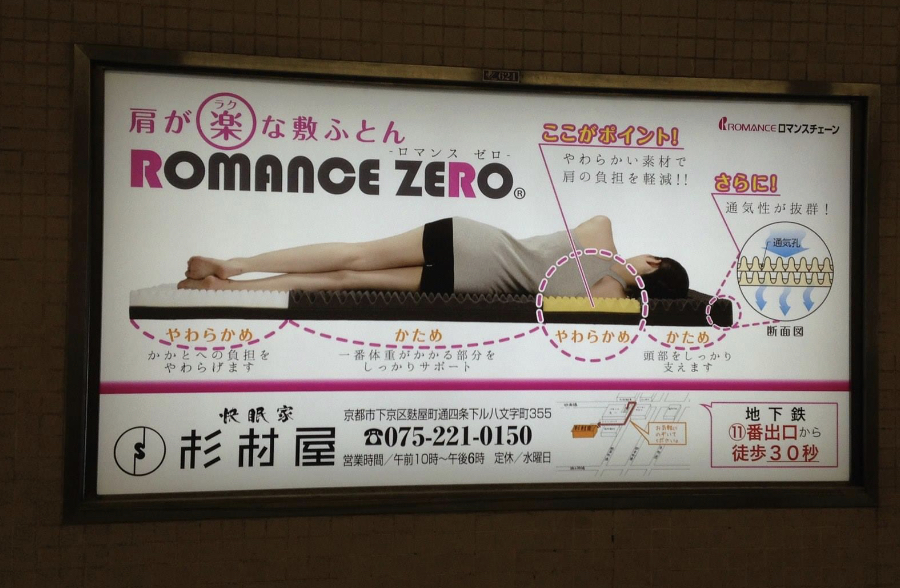
Is this understandable?
Is the English correct?
How would you write it differently?
I saw this ad in Kyoto and it made me laugh out loud. I understood it right away, though I wonder if Japanese people can understand it. Can you? The English is not correct, it should be zero romance. I would say Zero Romance. I think I would need to add in some small print explaining it though, perhaps it is there in the Japanese text already. The small print would explain why there is zero romance. The mattress is so comfortable that you will fall asleep right away and there will be no time for romance.
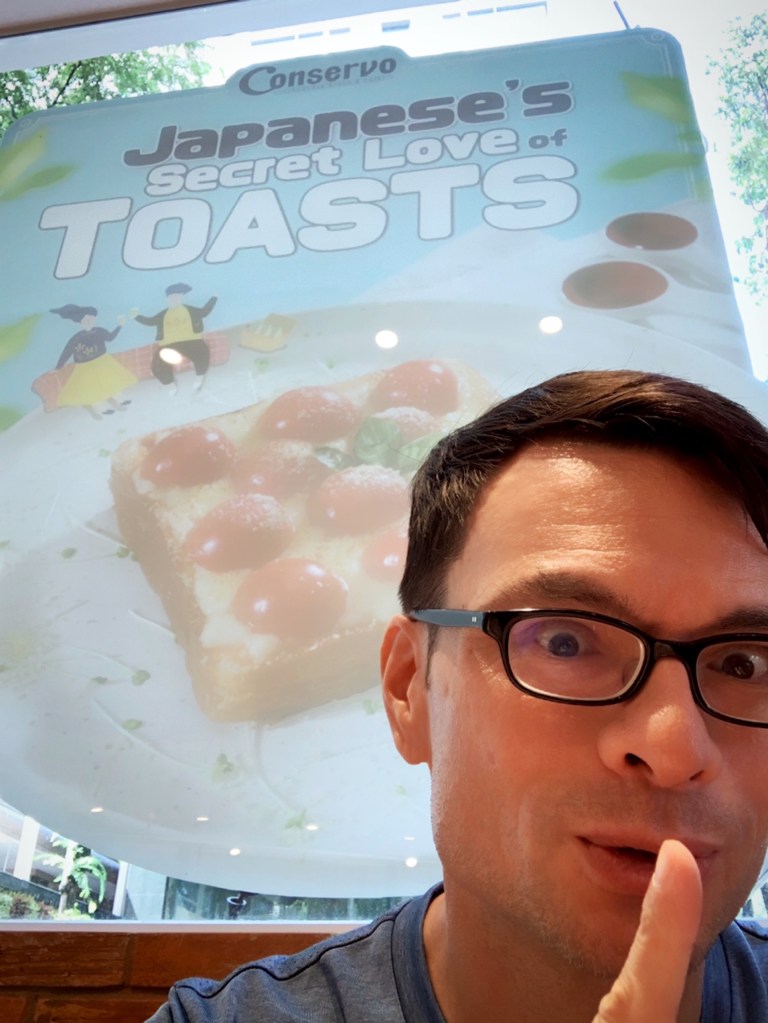
Is this understandable?
Is the English correct?
How would you write it differently?
This is a Japanese cafe in Saigon, apparently the secret is out. I understand the sign but I need a little more direction. Japanese doesn’t need the possessive ‘s, and toasts we’ll have to argue about forever. I prefer toast. I would add a little instruction and say ‘Discover the Japanese love of toast’.
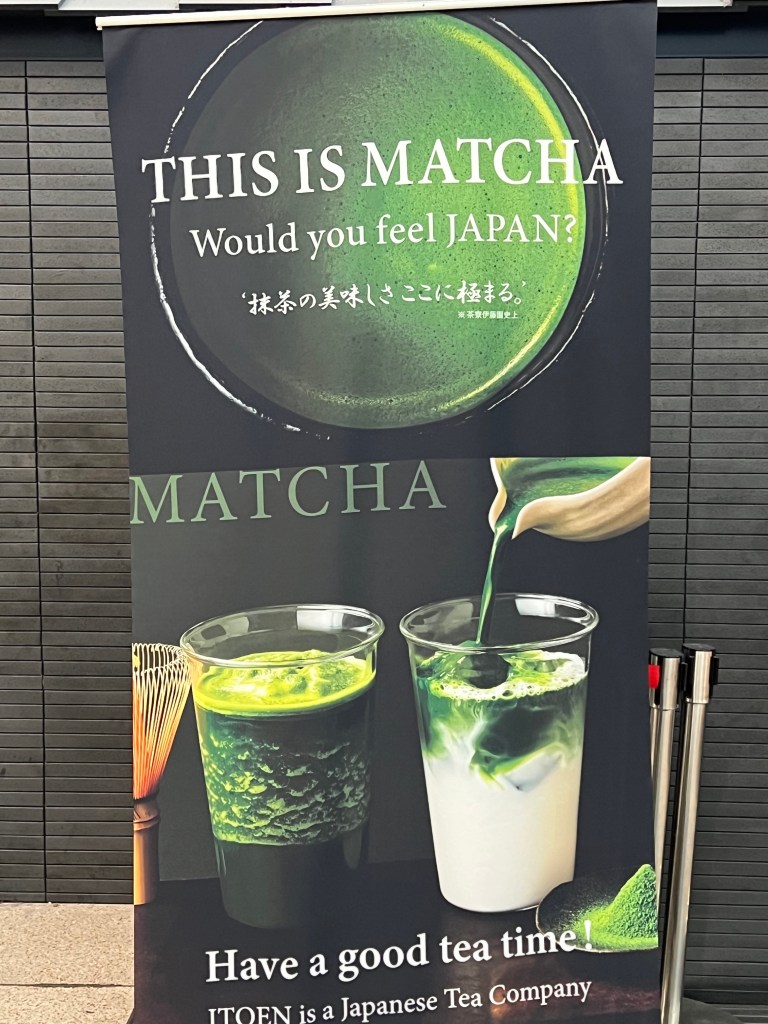
Is this understandable?
Is the English correct?
How would you write it differently?
I do understand this. I would like it to be written a little differently, but I hope they don’t change a thing because I love this. ‘Would you feel Japan?’ is charming. A bit old fashioned and more of a request or a very philosophical musing.
Would you fell Japan, please.
Would you fell Japan if you were to taste matcha?
The clearer way to ask this right now is ‘Do you feel Japan?’ or ‘Can you feel Japan?’
I might even say, ‘Can you feel it?’ It would be matcha and the Japaneseness of having matcha here and now.
‘Have a good tea time’ doesn’t mention matcha, so I would shorten it to ‘Enjoy matcha!’
And I would not explain what ITOEN is, a Japanese tea company. I think it is clear from the poster what ITOEN does.
What do you think?
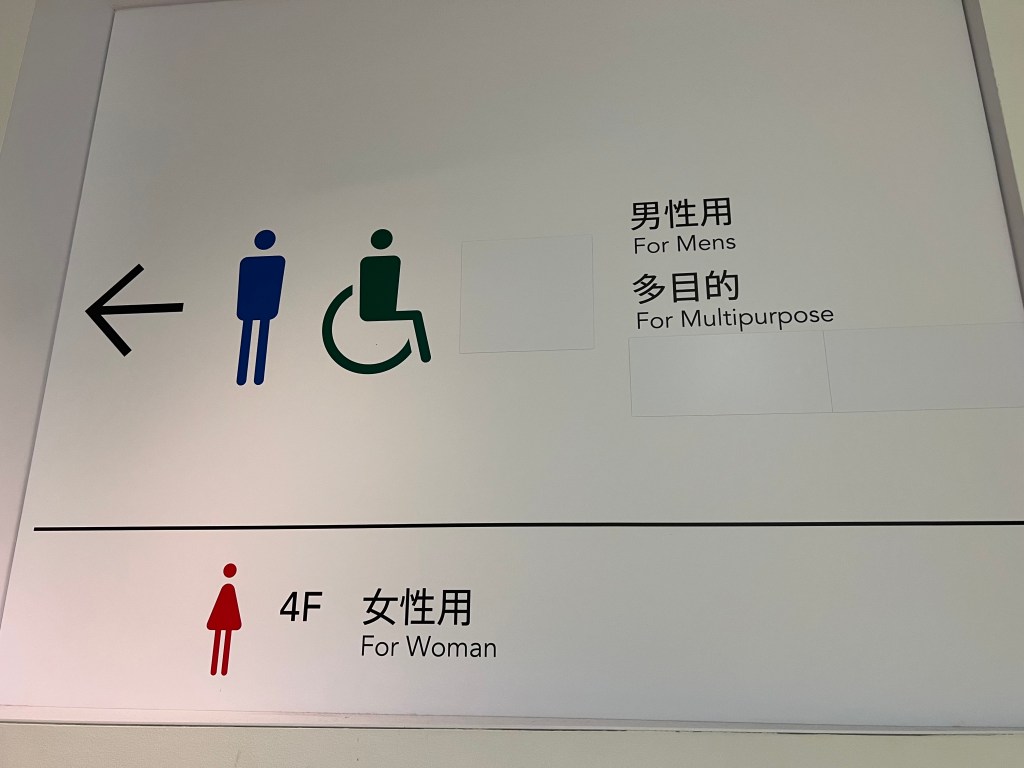
Is this understandable?
Is the English correct?
How would you write it differently?
In the sometimes urgent need of finding, and using, a bathroom this is understandable and actionable. The icons are clear enough on their own that the text isn’t even necessary.
The English is incorrect. The biggest problem seems to have been figuring out how to write and whether to use plurals. Generally you will see bathrooms identified by a simple plural on the door: Men and Women. People will talk about them using the possessive: Where is the men’s room? Men’s room means the bathroom for men. This sign has included a FOR which is unnecessary and unused in English.
Men is the plural of man. There is no S in the plural. The S here might be for possession in which case you would need an apostrophe.
Women is the plural of woman. The singular woman is used on the sign- but not womans. I don’t blame the sign maker, English has too many exception to rules and this poor person mixed it all up.
Multipurpose is an adjective so it needs a little something more ‘room’ or ‘use’. I’m not sure if there is a term for an ACCESSIBLE bathroom that also distinguishes it as being for men, women or any other combination. You may also still see the term HANDICAPPED though that is being used less and less.
I think, partly because of the urgency, icons alone are sufficient. Too much text slows people down and makes the information less understandable because there is too much information. Kind of like this post. Got a little long, didn’t it? Sorry.

Is this understandable?
Is the English correct?
How would you write it differently?
This is understandable, fluent even. Standard term and color choice. Blue for boys, pink or red for girls.
This is a bathroom in the bookstore Kinokuniya, so the reading bit is understandable. It is perhaps an open secret that so many of us read books or scroll our phones on the toilet. I’m not sure it is a habit we should be celebrating. Would you want to see a hamburger eating toilet icon at MacDonald’s?
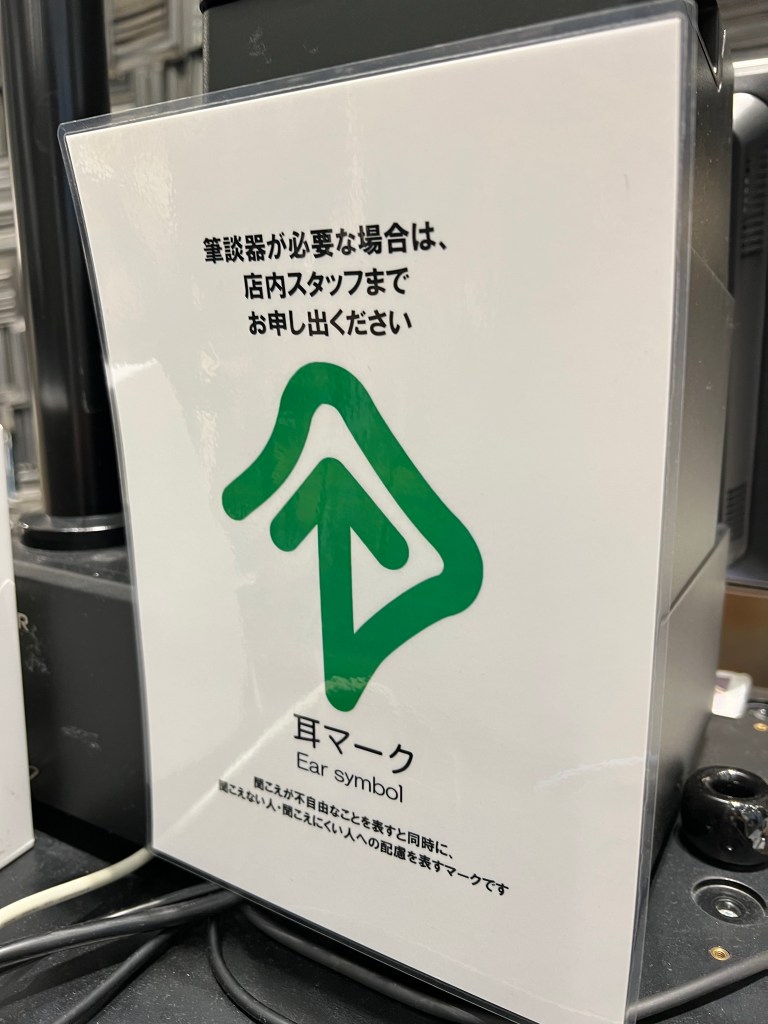
Is this understandable?
Is the English correct?
How would you write it differently?
This is an interesting sign by a cash register in Muji. It is a little confusing, but for people who need to know I think it makes sense. The staff didn’t seem to be people who need to know though and they weren’t quite sure what it really meant either.
The English ‘Ear symbol’ is the right idea but not the right meaning. I think. It is not so much a symbol for an ear, but a symbol for services provided to people who are deaf or hard of hearing. The clearer English is quite long though, ‘assistance for the hard of hearing’. This is where it may still work for people who need to know: look for the ear symbol.
I think it is a great idea, I hope it gets some better marketing.
 英会バー
英会バー 