You don’t have to speak good English to be a good listener. You just need to pay attention to the other person. Show them that you are listening. It’s not a test. You don’t have to understand everything they say- or anything at all. You can still be there for them.
I am here for you. I am listening.
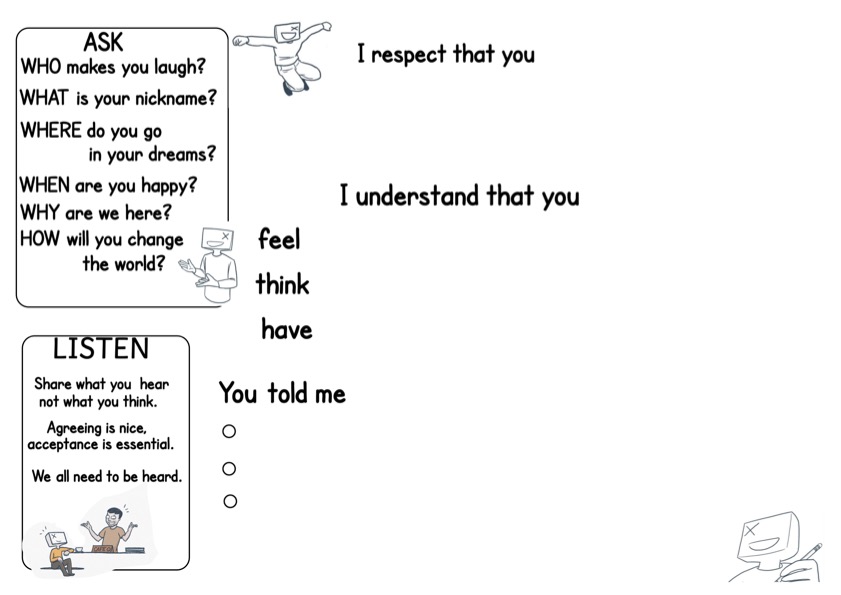
Assuming that you can understand enough of what they are saying you can be a good listener by sharing what you heard them say. Not what you think.
If somebody says, “I like cats.” You start with, “You said you like cats.”
If you say “I like cats too.” You are not really listening to the other person. You are getting ready to take over the conversation and make it all about you- and your favorite cat.
Once we establish that we are listening to each other and we trust each other, we can show that we care by asking better questions.
“What is your name?” “Where are you from?” These are questions from every text book. It feels like I am not really thinking and just throwing out the same boring stuff we had to do in school. I don’t care about our conversation. I don’t care about you. (Hidden meaning: Can we stop talking now?)
Ask questions that show you are thinking about the other person, that you are interested in them and their answers.
Instead of asking “What is your name?” try something like “What is your nickname?” Instead of “Where are you from?” ask “Where do you go in your dreams?”

This is a little tricky to do and takes practice and training. We need to be listening and we also need to be critical yet not interfere with our friend’s story to help them learn to express themselves better.
Most importantly we start by showing that we are listening to our friend, the person, and not their language.
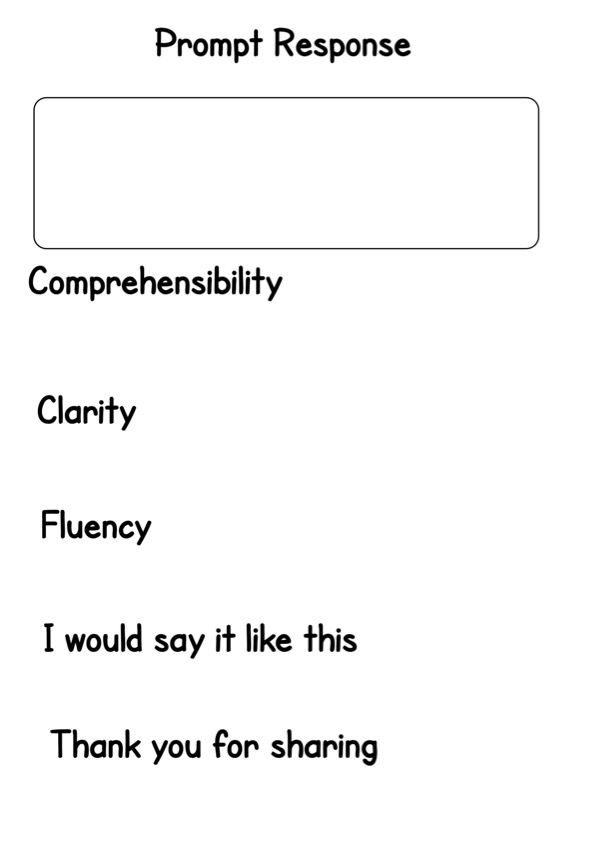
Tell the person what you heard them say without correction. You spoke to me, what you said is important, I am listening to you. After that we can get into correcting things by addressing comprehensibility. Telling our friend I want to understand you and here are some things that are not clear to me. Specific things.
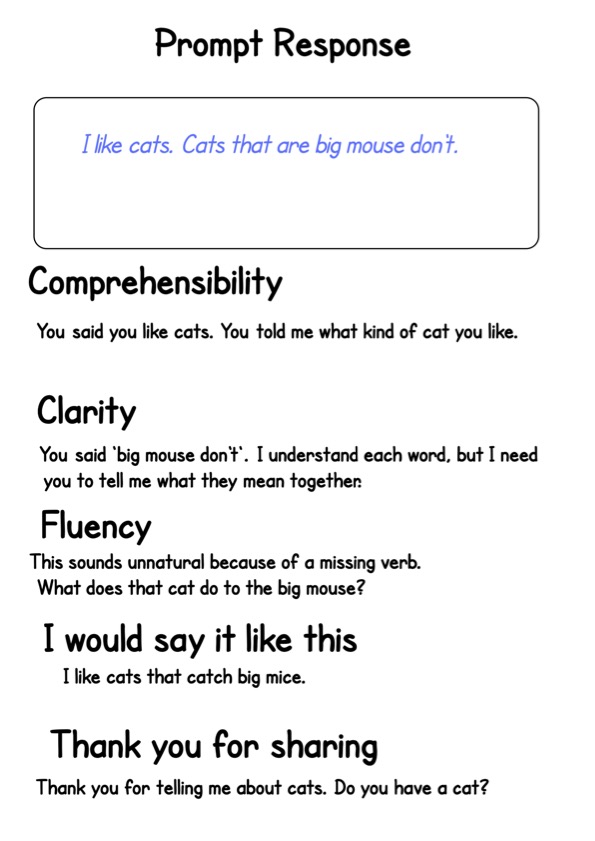
My friend said:
I like cats. Cats that are big mouse don’t.
You can start by showing them what is clear.
You said, “I like cats” This is clear and easy to understand. You also said, ” cats are …. ” This is a little confusing because each word makes sense but I don’t understand how the words fit together ( big mouse don’t).
You can help them make their sentences sound more natural. I often hear things that sound like Google translate. Yes it is English, yes it makes sense, no I wouldn’t say it that way.
I would say it like this, “I like cats that catch big mice.” You are not wrong. I am suggesting a way that I would say this. I am the teacher, the model speaker. My way of saying it may be more natural and more correct, but my way is not the only way. Your way can be good too.
Finish by thanking the person for sharing their story with you. That’s what language is for, sharing and connecting with each other.
 英会バー
英会バー 